
Why STEM and Robotics Education Is Creating the Generation of Innovators

The World Your Child Is Growing Into Is Changing Fast
STEM education for kids is becoming essential in a rapidly changing world. The world your child will enter as an adult looks nothing like the one we grew up in, with many jobs disappearing and new careers emerging faster than ever before.
This is exactly where STEM education for kids becomes transformative. When combined with hands-on robotics learning, STEM doesn’t simply teach children what to think. Instead, it shows them how to think, create, and innovate.
What Is STEM Education for Kids—and Why Does It Matter?
STEM stands for Science, Technology, Engineering, and Mathematics. However, STEM education for kids goes far beyond memorizing formulas or solving textbook problems.
At its core, STEM learning focuses on applying knowledge to real-world challenges. It encourages children to ask questions, experiment with solutions, and learn through experience rather than passive instruction.
For parents in India—where academic competition is intense—STEM represents a powerful shift. Instead of focusing only on exam scores, children begin developing lifelong skills that support success in any career path.
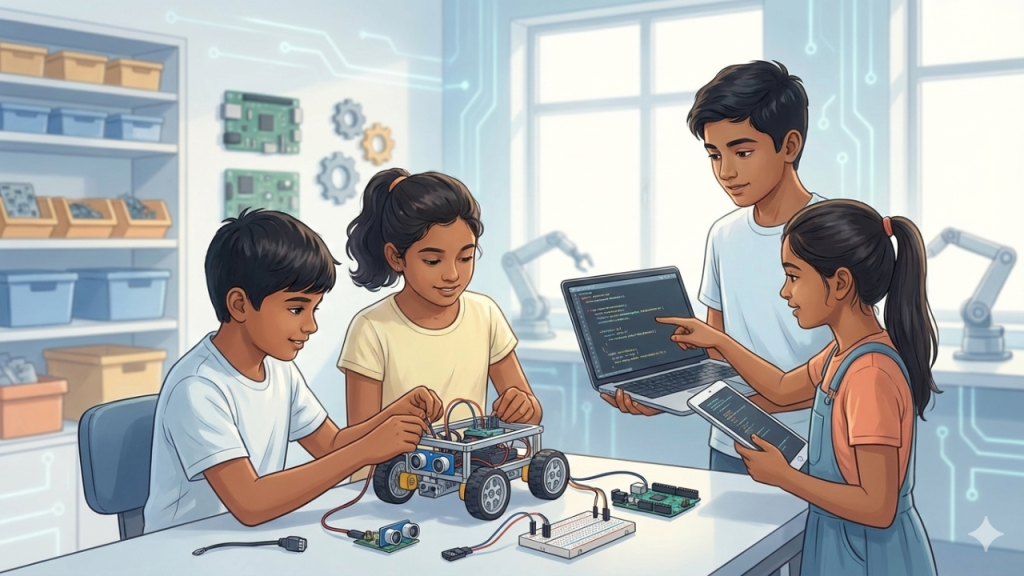
Moreover, when robotics for kids is added to STEM learning, abstract concepts suddenly become tangible. Children don’t just read about sensors; instead, they build systems that use them. Programming also becomes hands-on, as kids write real code that makes robots move.
Hands-on kits play a major role in STEM education for kids by turning theory into real-world action.
Explore our STEM Robotics Kits for Kids
How STEM Education for Kids Builds Innovation Skills Through Robotics
Innovation is not a mysterious talent reserved for a few. Instead, it is a skill that develops through practice, experimentation, and the right learning environment. Because of this, robotics learning for kids creates an ideal foundation for innovation to grow.
How STEM Education for Kids Develops Critical Thinking
When children build a robot, they must think several steps ahead. They choose components, plan how parts work together, and decide what to do if something fails.
As a result, each robotics project becomes a problem-solving puzzle. Children analyze situations, evaluate options, and make informed decisions. This form of active learning naturally strengthens critical thinking skills.
Creativity Meets Technical Knowledge
Some parents worry that technology-focused education might limit creativity. In reality, robotics often enhances it.
Children imagine what they want to create and then figure out how to bring that idea to life. For example, a simple automated gate can evolve into a smart system with sensors, counters, or displays.
Because of this balance, creativity and technical execution come together in the same way real-world innovation happens.
Logical Reasoning Becomes Second Nature
Through robotics projects, children learn to break complex problems into smaller, manageable steps. They test ideas, observe results, and refine their approach.
If a motor doesn’t spin, they ask why. Is the wiring loose? Is the code incorrect? Is the power supply insufficient? Over time, this cause-and-effect thinking becomes instinctive—and useful far beyond STEM subjects.
Failure Becomes a Learning Tool
In traditional education, mistakes often feel discouraging. Robotics learning completely changes that mindset.
Here, failure is expected and even encouraged. When a robot doesn’t work the first time, children simply try again. As a result, they build resilience, patience, and persistence—qualities shared by every successful innovator.
From Idea to Reality: How Robotics Nurtures Entrepreneurial Thinking
Innovation and entrepreneurship naturally go hand in hand, and robotics education helps children develop both.
The Complete Creation Cycle
In robotics courses for kids, children experience the full journey from idea to execution:
-
Ideation: Identifying a problem
-
Design: Planning a solution
-
Prototyping: Building the first version
-
Testing: Checking if it works
-
Iteration: Improving the design
This process closely mirrors how real products are created in the business world.
Real-World Problem Solving
The most impactful robotics projects solve real problems. When children build solutions for challenges they notice at home, in school, or in their community, they naturally begin thinking like innovators.
Over time, they start asking better questions such as, “How can this work better?” or “What can I improve?”
Collaboration and Communication
Most robotics programs involve teamwork. Children share ideas, divide responsibilities, and work together toward a common goal.
Because of this collaboration, they develop communication and teamwork skills—both essential ingredients behind real-world innovation.
Real Robotics Projects That Spark Innovation
Students involved in STEM learning in India often build projects such as:
-
Automatic Toll Booth Systems using sensors and motors
-
Smart Dustbins with motion-based lid control
-
Temperature Monitoring Systems with alerts
-
Line-Following Robots for automation logic
-
Smart Home Models demonstrating IoT concepts
Each project blends physics, coding, mechanics, and mathematics—turning theory into something real and functional.
Why STEM Education for Kids Needs Hands-On Robotics Learning
Although coding apps have value, they cannot replace physical robotics learning.
Tangible Results Build Confidence
Seeing a robot move because of your own code is far more powerful than watching an animation.
Multi-Sensory Learning
Robotics engages sight, touch, sound, and movement, which leads to deeper understanding.
Real-World Constraints
Unlike perfect digital environments, real robots face gravity, friction, power limits, and mechanical issues. Solving these challenges prepares children for real innovation.
How Parents Can Support Innovation at Home
You don’t need technical expertise to nurture innovation. Instead, simple actions make a big difference:
-
Encourage curiosity and questions
-
Allow time for unstructured experimentation
-
Celebrate effort, not just results
-
Create a small space for building and tinkering
-
Share stories of inventors and problem-solvers
Together, these habits reinforce an innovation mindset.
Choosing the Right STEM Education for Kids Program
When selecting robotics courses for kids, look for:
-
Hands-on learning
-
Project-based curriculum
-
Age-appropriate difficulty
-
Qualified instructors
-
Progressive skill development
Therefore, structured programs provide guidance, tools, and peer learning that accelerate growth.
For parents seeking this balance, Robokidz offers age-appropriate robotics learning for kids—combining hands-on projects with expert mentorship and small batch sizes.
Structured STEM education for kids programs provide guided learning, expert mentorship, and progressive skill development.
Learn more about our STEM and Robotics Courses for Kids
Start Building the Future Today
Innovation isn’t something children will need someday—it’s something they can develop right now.
Every STEM education for kids journey begins with curiosity. The earlier children experience the joy of creating, solving, and improving, the more naturally innovation becomes part of how they think.
The next generation won’t just consume technology—they’ll build it.
Give your child the foundation to not only imagine the future, but to create it.